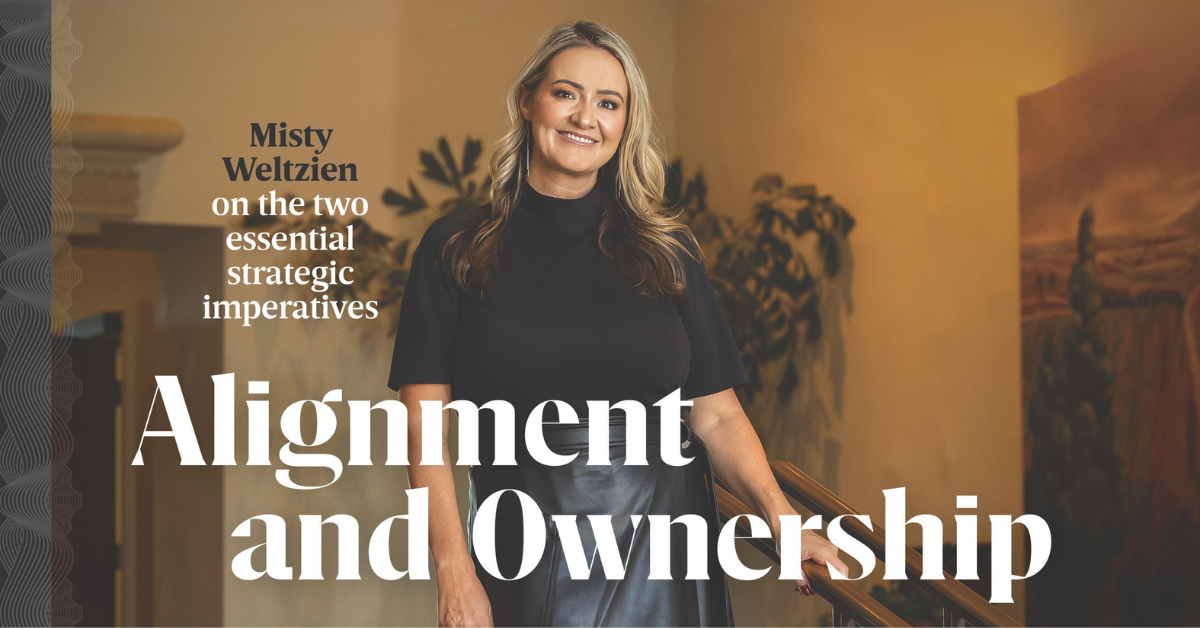
By Misty Weltzien
LIKE WINGS ON A PLANE, THESE ARE THE TWO ESSENTIALS NEEDED TO KEEP YOU ON COURSE
In today’s fast-evolving financial services landscape, agency leaders are navigating more than market volatility and regulatory shifts—they’re contending with deeper questions of culture, purpose and performance.
As we address those issues at our firm, two words— alignment and ownership—have evolved from aspirations into strategic imperatives.
Why these two?
Because without alignment, even the best ideas scatter. Without ownership, even the best talent stalls. The two are like wings on a plane, working together to keep us on course.
Alignment ensures that every individual, from advisors to support staff, understands and works toward the firm’s mission, goals and values. It eliminates silos, reduces inefficiencies and creates a unified front to deliver exceptional client outcomes.
Ownership, on the other hand, empowers team members to take initiative, act as stakeholders and treat the firm’s success as their own. Together, these principles transform a firm from a collection of individuals into a cohesive, high-performing organization.
Let’s explore how agency leaders can cultivate both—moving beyond slogans to systems, beyond motivation to mobilization.
STEP 1: A Clear, Compelling Vision
In our company, alignment isn’t forced—it’s forged.
It begins with a shared destination. A well-articulated vision serves as the North Star, guiding decisions and behaviors across the firm. As a leader, your first task is to ensure your vision is clear, compelling and relevant to your team and clients. That requires:
• Being Client-Centric: In financial services, your vision and mission should resonate with the impact you create for clients—whether it’s securing their financial futures, simplifying complex decisions or empowering wealth creation. For example, our vision—“To elevate financial practices to help people achieve lifetime freedom”—anchors our team’s efforts in a shared purpose. Our mission is to help people “Create a good life for the rest of their lives.”
• Involving Your Team: Engage key stakeholders in refining the vision. Host meetings or town halls to gather input from advisors and support staff. This inclusivity fosters buy-in and ensures the vision reflects diverse perspectives.
• Ensuring Clarity: A vision that can’t be recited won’t be remembered. Many times, company vision statements are lengthy paragraphs. Most people can’t recall long statements like that. Craft a compelling, concise statement that every team member can internalize and share. When your people know “why” and can speak it confidently, alignment and ownership follow naturally.
• Communicating Relentlessly: A vision is only effective if it’s lived daily. Use every channel—team meetings, newsletters and performance reviews—to reinforce the vision. At Pacific Advisors, our quarterly meeting always includes a story of how our work changed a client’s life, tying actions back to our purpose.
Action Item: Within the next 30 days, review your firm’s vision and mission statements. Are they specific enough to guide decisions? Are they recitable? Do they inspire your team? If not, schedule a leadership offsite to refine it, ensuring it’s both aspirational and actionable.
STEP 2: Alignment Across Levels
Once the vision is set, translate it into measurable goals that cascade through the organization. Misaligned goals— where departments or individuals prioritize conflicting objectives—can erode trust and efficiency. In financial services, where client outcomes depend on collaboration between advisors, leaders and operations, alignment is nonnegotiable.
• Set Firm-Wide KPIs: Adopt objectives and Key Performance Indicators (KPIs) to align priorities. For example, if your firm aims to grow assets under management by 15% in the next year, break this into specific objectives for advisors (e.g., deepen client relationships), marketing (e.g., generate qualified leads) and operations (e.g., streamline onboarding). Ensure each team’s KPIs ladder up to the firm’s goal.
• Track Progress Transparently: Use dashboards or regular updates to share progress on key metrics. Transparency builds accountability and shows how individual contributions drive fi rm success. We use a tool called Bloomgrowth to track metrics, but even a simple shared spreadsheet can keep everyone on the same page.
• Align Incentives: Ensure compensation and recognition systems reward behaviors that support the firm’s goals. Every award at our firm is tied to the client outcome it generates.
Action Item: Audit your firm’s goals and incentives. Do they encourage collaboration or competition? Implement a unified KPI framework and review it regularly to ensure alignment.
STEP 3: A Culture, Not Just a Concept
Ownership thrives when team members feel trusted, valued and empowered to make decisions. In financial services, where client relationships demand agility and personalization, empowering your team to act like owners can differentiate your firm.
Our firm’s values anchor our desire to create this culture of ownership through our DEEDS:
- Do the Right Thing
- Elevate Community
- Embrace Teamwork
- Drive Improvement
- Solve the Problem
Specifically, Drive Improvement and Solve the Problem directly encourage our team members to act swiftly within their roles to engage in an ownership mindset when challenges arise.
These values aren’t wall art; they’re operational expectations. We hire, coach and even make hard parting decisions based on them.
• Invest in Development: Ownership grows when employees see a future with your firm.
– Offer training in leadership, financial planning certifications (e.g., CFP, CLF or RICP) or soft skills like client communication. In 2024, fi rms that invested in employee development saw 15% higher engagement, per Deloitte.
– Annually, we pick a designation to offer in a group format for our fi rm. In 2024, we had over 25 advisors all accomplish the CLTC (Certified in Long Term Care) designation together. In 2025, we chose the TPCP (Tax Planning Certified Professional) designation to study as a group.
– For agency staff development, we recently signed up for an enterprise level MasterClass subscription to let our team self-guide their learning. Some of our members are working on personal development like mental health, others are learning how to use AI tools. So far, the feedback from the team has been incredible.
• Celebrate Initiative: Recognize and reward those who go beyond their job descriptions. At Pacific Advisors, we have an award that recognizes staff members who make the largest impact on our fi rm’s community for the year.
Action Item: Look at your development track within your firm. Are both advisors and staff included? What steps can you take to make sure your learning and development are in direct alignment with your mission?
STEP 4: Emphasize Trust and Collaboration
Alignment and ownership flourish in a culture where trust is the foundation. In financial services, where sensitive client data and high-stakes decisions are routine, trust between team members and leadership is critical.
• Lead with Vulnerability: Share your challenges and mistakes as a leader to model openness. In our firm, we lead with transparency and own our mistakes. Doing so opens the door for others to share ideas without fear of judgment.
• Encourage Cross-Functionality: Break down silos by creating cross-departmental team meetings to tackle firm wide challenges, like improving recruiting or client experience or adopting new technology. Every week we have our operations team leaders meet with leaders of sales teams to identify issues and collaboratively problem-solve.
• Solicit and Act on Feedback: Use anonymous surveys or open forums to gather honest input. More importantly, act on it. It’s essential to demonstrate that your team’s voices matter. A 2024 Harvard Business Review study found that firms with high trust levels saw 50% higher productivity and 13% lower burnout rates. Trust isn’t just nice to have—it’s a performance driver.
Action Item: Conduct a trust audit. Use a short, anonymous survey to gauge team trust in leadership and collaboration across departments. Share results and commit to one tangible improvement based on feedback.
STEP 5: Leverage Technology
Increasingly, technology is a force multiplier for alignment and ownership. The right tools can streamline communication, enhance transparency and empower team members to take initiative.
• Centralized Communication Platforms: Tools like Slack, Microsoft Teams and Bloomgrowth (the one we use) keep everyone aligned by centralizing updates, KPI tracking and discussions. Create channels for firmwide goals, success stories and team wins to reinforce shared purpose.
• Client Management Systems: A robust CRM (e.g., Salesforce, Redtail, Smart Offi ce) ensures advisors and support staff have a single source of truth for client data, reducing errors and fostering collaboration. Train your team to use these systems to take ownership of client relationships.
• Automation for Efficiency: Automate repetitive tasks to free up time for high-value work. We are constantly looking for what we can automate to allow the team to focus on client and recruit engagement. In 2024 we invested in a training tool called Brevity, which allows our new advisors to role-play their scripts with an AI “prospect.” This tool alone has saved our leadership team tens of hours per month and has improved outcomes for our new advisors.
Action Item: Evaluate your tech stack. Identify one tool or process that could enhance alignment or empower ownership and pilot it with a small team before scaling.
Trust isn’t just nice to have—it’s a performance driver.
RELEASING THE POWER OF REPRESENTATION
As a woman navigating and leading in this industry, I’ve found that alignment and ownership aren’t just strategic tools—they’re equalizers. When clearly defined and actively nurtured, they ensure that every voice is heard, regardless of title or tenure. In historically male-dominated spaces, creating this kind of culture isn’t just good business—it’s an act of leadership transformation.
So as more women step into leadership roles across our industry, let’s commit to building cultures where every leader—regardless of gender—has the opportunity to rise, contribute meaningfully and thrive. Representation is not just progress—it’s power. And when women lead authentically, the entire industry benefits.
For example, women often lead with collaboration, empathy and vision—traits that are essential when forging alignment. I’ve noticed that when female leaders facilitate vision-setting sessions, there tends to be more inclusion of “how people feel” in the process—not just what they do. This emotional connection fosters buy-in and long-term commitment that metrics alone can’t deliver.
For many women, especially those rising in traditional environments, vulnerability can feel risky. But I’ve found it’s actually a source of strength. When I lead with candor and clarity—admitting when I don’t have the answer—it opens up space for others to contribute, innovate and lead.
Research consistently shows that women in leadership roles are more likely to coach, mentor and develop others. In my experience, this developmental leadership style naturally fosters ownership—when people feel seen, supported and challenged, they rise. As women in leadership, we model ownership by giving others space to lead—while firmly holding the line on values.
For women agency leaders reading this: our presence matters. Only a fraction of fi rms in our industry are led by women, and yet our impact is profound. When we lead visibly—especially in building inclusive cultures—we inspire not just our teams, but the next generation of advisors and leaders. Alignment and ownership give us the tools to lead authentically and effectively.
Overcoming Common Challenges
Creating alignment and ownership isn’t without hurdles. Here are three common challenges and how
to address them:
1. Resistance to Change: Some team members may resist new goals or responsibilities. Engage them early in the process, clarify the “why” behind changes and provide training to build confidence.
2. Misaligned Priorities: If departments pursue conflicting goals, revisit your KPI framework and ensure leadership models unified priorities.
3. Burnout from Over-Empowerment: Giving too much autonomy without support can overwhelm employees. Pair empowerment with clear guidelines and regular check-ins.
While this article is written for all agency leaders, I’d be remiss not to acknowledge the quiet, persistent challenge of navigating bias—something many women leaders know well (see sidebar page 34). Female leaders may face unspoken biases when making assertive changes or empowering others. It’s important to stay anchored in your values and strategy. Let outcomes—and culture—speak for themselves. Building a culture of ownership protects against the perception that leadership is top-down or exclusive.
To ensure your efforts are paying off, track these key indicators:
• Employee and Advisor Engagement: Use surveys to measure alignment with the firm’s vision and sense of ownership. Aim for a 10% improvement in engagement scores by year-end.
• Client and Recruiting Outcomes: Monitor client and recruitment satisfaction and retention rates, as aligned and empowered teams deliver better experiences.
• Financial Performance: Track revenue growth, assets under management or referral rates to quantify the business impact.
As an agency leader or managing partner, your ability to create alignment and ownership will define your firm’s success. By defining a clear vision, aligning goals, empowering your team, fostering trust and leveraging technology, you can build a culture where every member is invested in the firm’s mission and empowered to drive results.
Start small—pick one action item from this article—and commit to implementing it within the next quarter. The ripple effects will transform your firm into a powerhouse of collaboration and impact.
Alignment and ownership aren’t just business strategies—they’re cultural commitments that create space for real, inclusive growth. Whether you’re blazing your own trail or lifting others along the way, this is the moment to lead boldly.
Build a culture where every member is invested in the firm’s mission and empowered to drive results.
_
MISTY WELTZIEN is CEO of Pacific Advisors in Newport Beach, California, which she joined in 2012 after five years with Northwestern Mutual. In addition to her executive leadership role, she is also a speaker and author and serves on the board and executive committee at Finseca.